

What's with the Shamrocks?

White House photo by Adam Schultz/ Image in the Public Domain / No rights expressed or implied
This post was originally written in 2017 and was updated in 2026
Each year the Irish Prime Minister (An Taoiseach) visits the White House on or around St. Patrick's Day for what has become known as the Shamrock Ceremony, where he presents a Waterford Crystal bowl filled with shamrock to the President of the United States in recognition of the two countries special bond. The official exchange and photo op is joyfully followed by a festive reception for guests at the White House. The festivities actually begin much earlier in the day with a sit down St. Patrick's Day lunch. This tradition began, on a much smaller scale, during the Truman administration when, in 1952, the Irish Ambassador to the US John Hearne dropped off a box of shamrock plant to the White House with a note from then President Seán T. O’Kelly which read “Happy St. Patrick’s Day with compliments of the President of Ireland”. Ironically President Truman was not home at the time but rather on vacation.
So what's all the fuss about?
To answer that question we need to go back to the founding of the countries. Anyone who has read modern history would have little choice but to appreciate the strong connection between the US and Ireland. A few notables:
Of the 56 signers of the Declaration of Independence eight (8) were Irish Americans, three (3) of whom were Irish born - James Smith, George Taylor and Matthew Thornton.
Many Irish fought and died in the American Civil War.
The Irish Proclamation of Independence (Easter Proclamation) of April 24, 1916 specifically mentions America in its text:
"... she (Ireland) now seizes that moment, and supported by her exiled children in America ..."
America continued to be a bastion of support for Irish independence and consequently for peace in the northern part of the island. Many Irish of course immigrated to the United States to work and send money back home to aid their families in Ireland. The first shamrock ceremony, as referenced earlier, was post World War II and there is some thought that Hearne was motivated to try and warm the relationship with the US given Ireland's neutrality during the war.
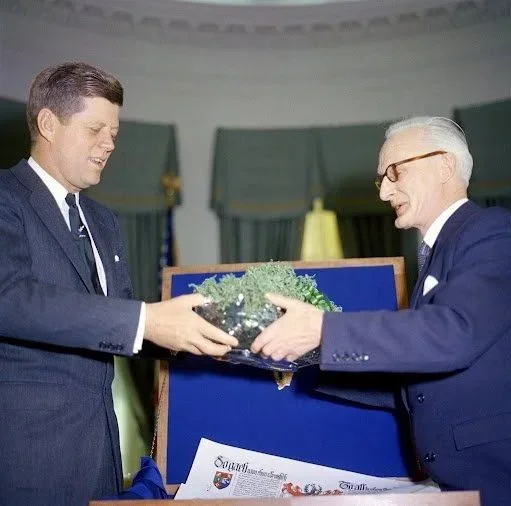
President John F. Kennedy being presented with a bowl of shamrock by Thomas Kiernan Ireland’s Ambassador to the United States. White House archived image / In the Public Domain / No rights expressed or implied
With different administrations came different levels of interest in the tradition. Obviously the election of John F. Kennedy was a game changer in terms of recognition and appreciation of not just Irish heritage but also Catholicism. As the first Catholic ever elected to the Office of the President, JFK was the embodiment for so many Irish and Irish Americans of what they and their families had sought - recognition, acceptance and, most of all, respect. It was a personal moment for President Kennedy who felt immense pride in his heritage. He famously said that although Ireland was not the country of his birth it was the country for which he had the most affinity. After his death, Mrs. Kennedy would place the shamrocks by his grave during the remainder of his term of office.

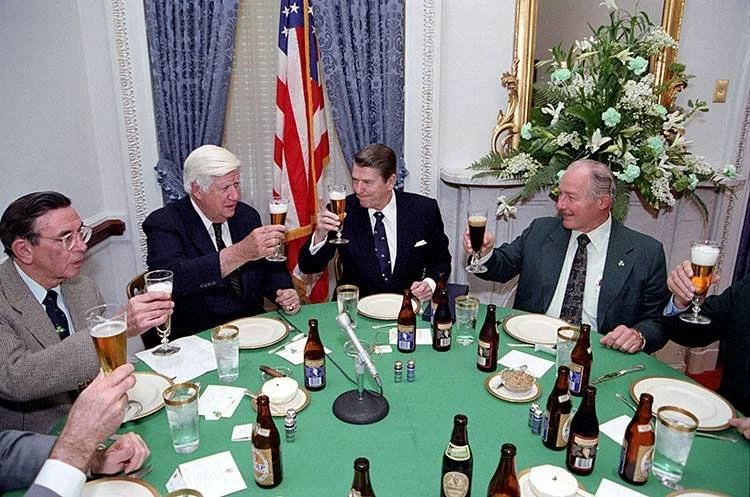
Other Administrations followed and all maintained the shamrock ceremony on or around St. Patrick's Day. President Ronald Reagan, a very proud Irish American, found particular enjoyment with the ceremony and added speaking programs as a way to educate Americans about the current state of affairs in Ireland, as did President Bill Clinton. Massachusetts’s own Thomas P. “Tip” O’Neill began another tradition of a St. Patrick’s Day lunch at the U.S. Capitol in 1983 and invited Ronald Reagan, at which corned beef and cabbage was served. The tradition continues today with the Speaker of the House and the Friends of Ireland Caucus sponsoring the lunch and inviting the then sitting President. With the Reagan years, it was the Taoiseach who was the invited guest to the White House rather than the Irish Ambassador as in previous years. All of the taoisigh since have made the annual visit to the White House on or around St. Patrick’s Day.
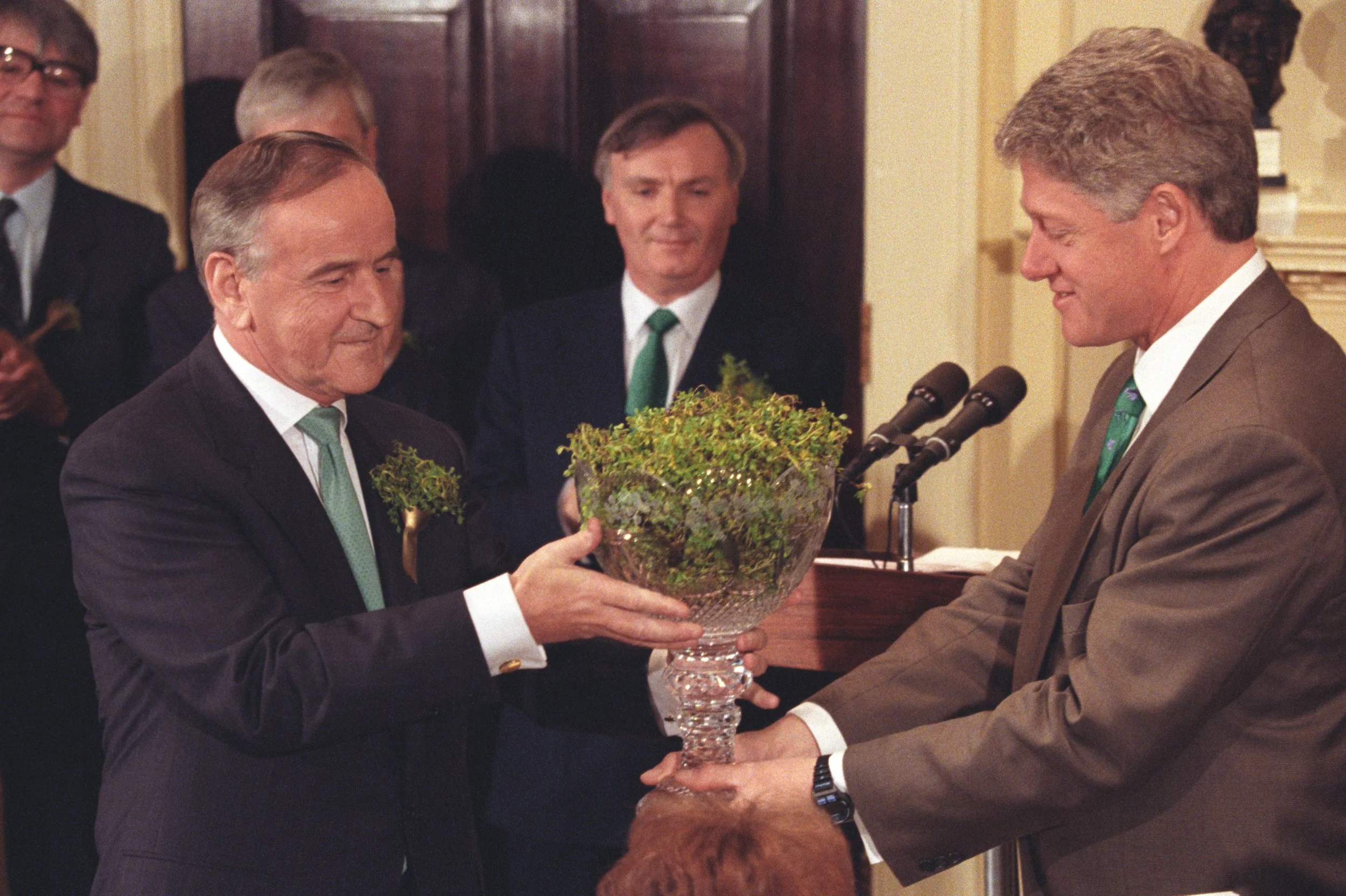
President Bill Clinton being presented a bowl of shamrock by Irish Taoiseach Albert Reynolds. White House archived photo / Image in Public Domain / No rights expressed or implied
President Clinton changed the dynamic considerably by adding a political element in his proactive and unwavering support of peace in Northern Ireland. His interest was made clear early on when, as a presidential candidate, he acknowledged that he would advocate for a visa for Gerry Adams - the leader of the Sinn Fein political party in Northern Ireland. It was a risk as both a candidate and as a President but the gamble paid off and Clinton's administration was integral in helping to shape and realize the Good Friday Agreement, with incredible contributions from people like former Senator George Mitchell. Accordingly, Clinton's White House St. Patrick's Day guests included not only An Taoiseach and the Ambassadors but also the political leaders from Northern Ireland - a first. In 2000, Clinton hosted Northern Ireland politicians Gerry Adams, President of Sinn Fein, John Hume, President of the Social and Democratic Labor Party (SDLP) and David Trimble, First Minister of the Stormont Assembly. Upon the signing of the Good Friday Agreement, Clinton famously said, “After a 30 year winter of sectarian violence, Northern Ireland today has the promise of a springtime of peace.”
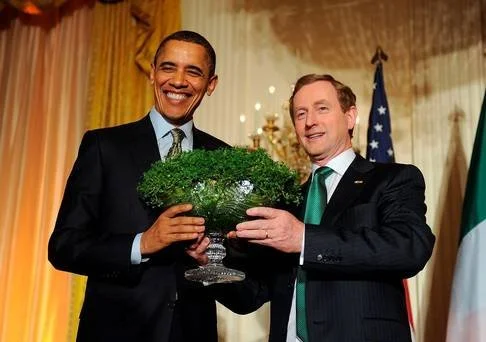
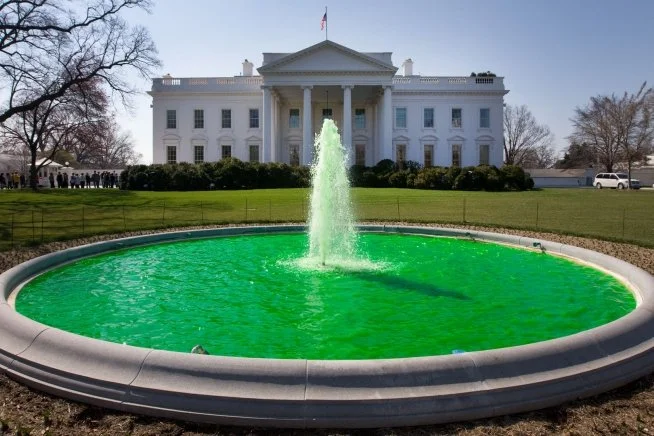
Today the ceremony is mainly celebratory where the political leader of Ireland is provided a unique opportunity to present his American "wish list" for Ireland to the leader of the free world. A key focus has been the economic ties between Ireland and the US, particularly foreign direct investment from America into Ireland, and immigration reform to assist the undocumented Irish in America. President Barack Obama added green dye to the fountain in front of the White House, the obvious inspiration for which was his home town’s dying of the Chicago River. Obama referred to the ceremony as an affirmation of one of the strongest bonds between peoples that exist in the world. President Obama did not learn of his Irish lineage until he was in the White House - a fact he pointed out at one of the Speaker of the House / Friends of Ireland Caucus lunches by commenting that such knowledge, as a son of Chicago, could have delivered him to Washington "sooner".
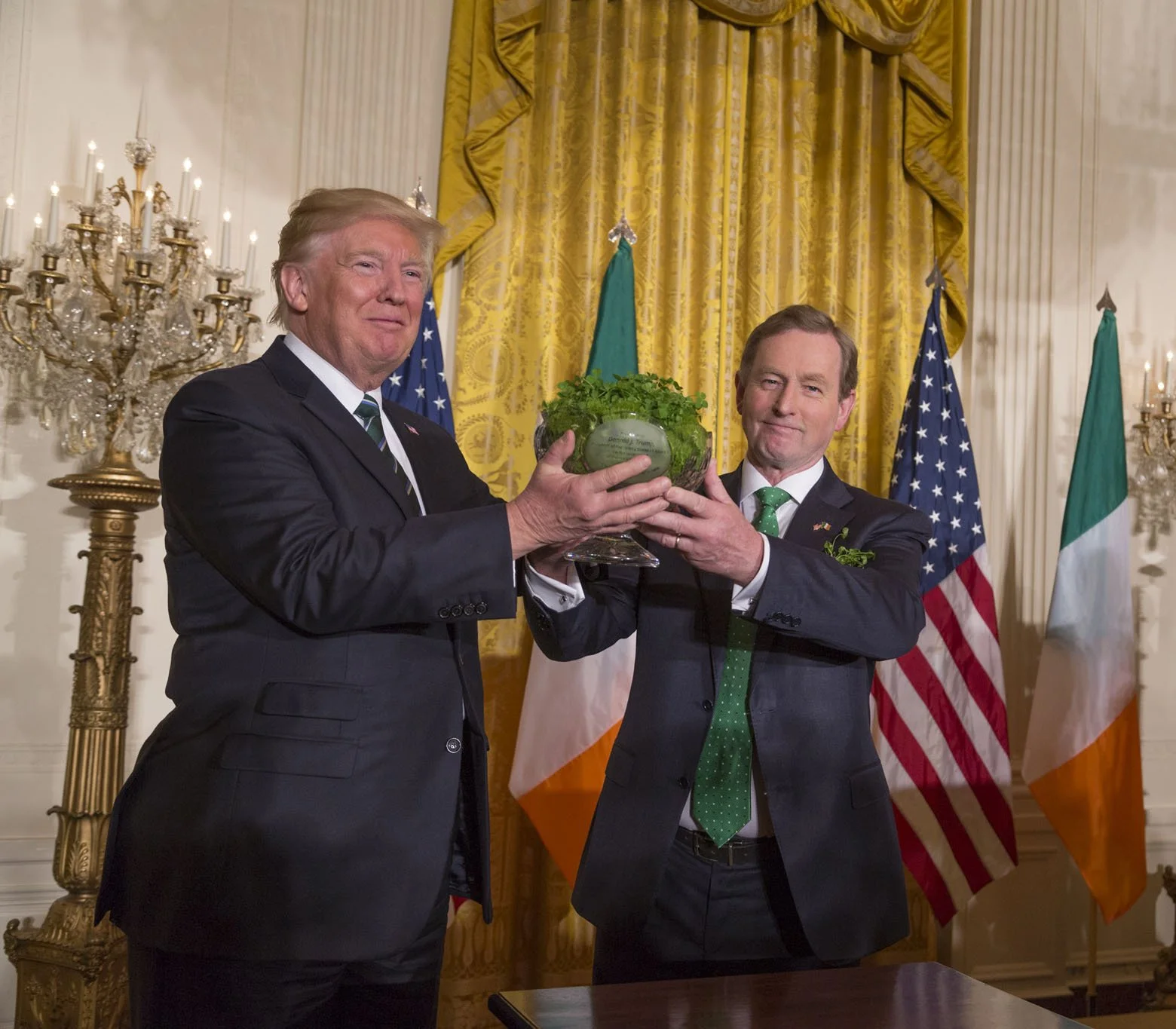
Irish Taoiseach Enda Kenny presenting President Donald Trump with the bowl of shamrock / White House Archive / Image in Public Domain / No rights expressed or implied
Regardless of politics, it was indeed encouraging to see that the time honored tradition of the shamrock ceremony continued into the Trump Administration. In 2017 (original year of this post) St. Patrick's Day occurred at a time when the political climate in both countries was, in many respects, unprecedented. Despite considerable criticism he received at home, Taoiseach Enda Kenny traveled to the US for St Patrick's Day to visit with President Trump. The traditional asks on behalf of his country, however, were met with a different set of ears than he was used to. Trump had and continues to demonstrate a very different view of immigrants than that of, at the very least, his immediate predecessor (Barack Obama) and many believed was uninterested in working to find ways to integrate any of the so-called undocumented - Irish or otherwise. Further, he supported a tax on imported American goods which are produced by American companies abroad and wanted to see a revamp of the US tax code, which in part will be aimed at enticing US companies with foreign HQs and/or operations to physically and legally return home. Many such US companies currently call Ireland home. We delved into this matter in greater detail in the post Taraif.
Unfortunately for Enda Kenny, this was his last visit to the White House as Taoiseach. He was under considerable political stress in his own government compounded by the sobering consequences of Brexit and the prospect that Ireland may be forced back to the days of a physical border between the Republic and the 6 counties of the North, making that exchange between the two leaders over the shamrock bowl critically important.
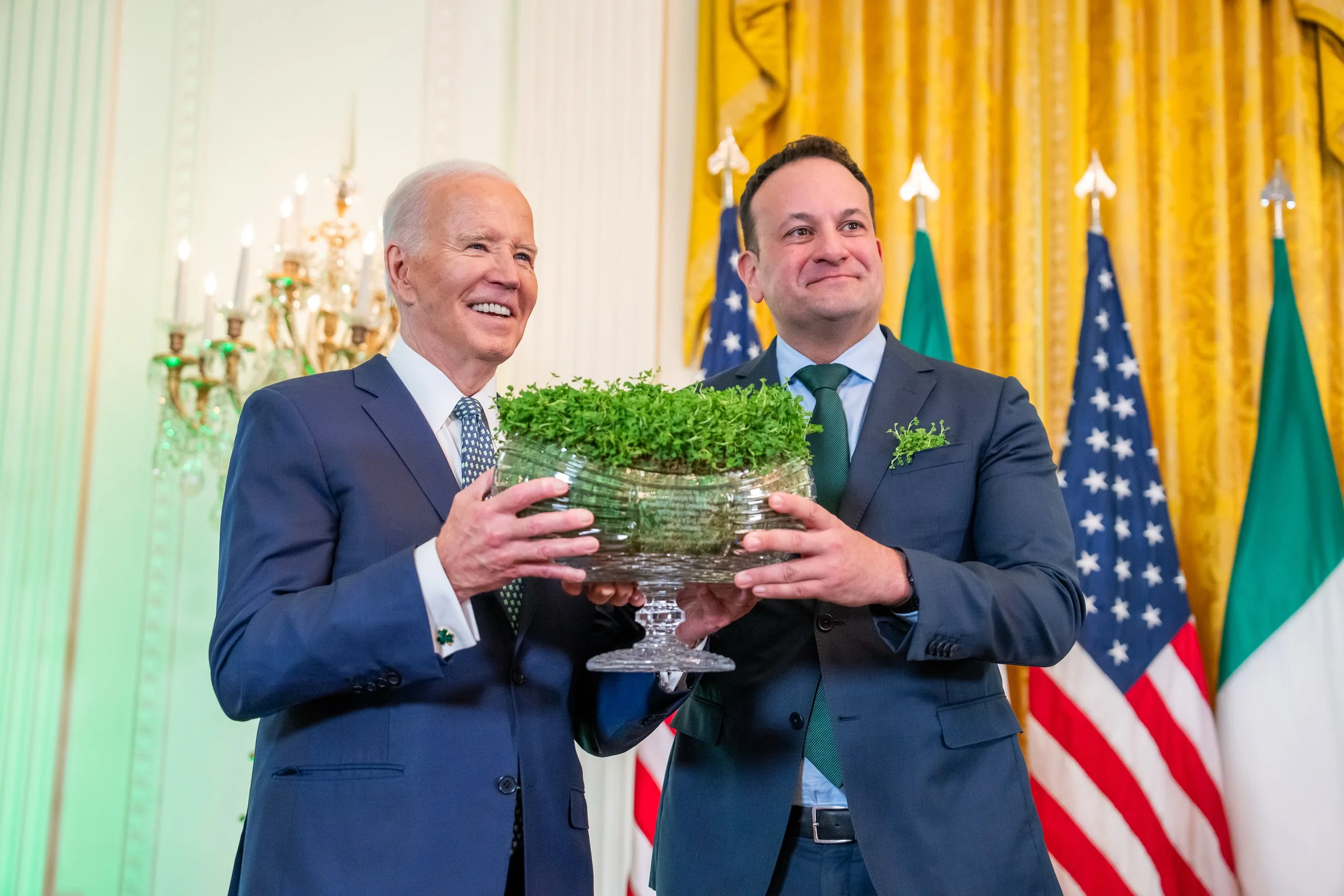
President Joe Biden being presented with the bowl of shamrock by Taoiseach Leo Varadkar. White House archived image / Image in Public Domain / No rights expressed or implied
With the Biden Administration, enthusiasm for the annual Shamrock Ceremony grew significantly, given the President’s Catholicism and his great affinity for his Irish heritage. He often stated that Ireland was “part of his soul”. Unfortunately, however, Biden’s first year in office brought with it the COVID virus and by the 17th the country was in full shut down mode. But that didn’t stop an event from happening, albeit virtually with then Taoiseach Micheál Martin. The same format continued in 2022 because Martin tested positive for COVID. Accordingly, the Irish government shipped the shamrock to the White House before the event so they could be displayed with the President sitting in the Oval Office.
The event returned to a live visit in both 2023 and 2024 hosting Taoiseach Leo Varadkar. Biden used the ceremony to celebrate Irish heritage, strengthen U.S.-Ireland diplomatic ties, and honor the Good Friday Agreement. He demonstrated, in many ways, his seriousness about supporting Northern Ireland and the Good Friday Agreement, not the least of which was appointing former Congressman Joseph P. Kennedy III to the post of Special Envoy to the province. In 2023, President Biden made a historic visit to Ireland visiting both the north and the south. The trip came during the anniversary of the Good Friday Agreement signed on April 10, 1998. He seemed to particularly enjoy his time in Belfast and in his ancestral home of Ballina in County Mayo. March 2024 marked the final St. Patrick’s Day for President Biden in the White House. There were calls for Taoiseach Varadkar to boycott the annual visit because of the Administration’s support of Israel and in particular Israel’s attacks on Gaza, but the government believed that to snub the White House would amount to a serious mistake.
President Trump continued the shamrock ceremony in 2025, the first year of his second term and extended a formal invitation to Taoiseach Micheál Martin for March 12th at the White House. When asked, the Taoiseach said on RTE’s the Late Late Show “I have never met Donald Trump, but I am looking forward to meeting him.” Last year was indeed significant given the tariff threat and the ongoing situation in Gaza and again prompted careful consideration if the Taoiseach should even attend. I have no doubt that the Taoiseach’s advisors prepared him for a grade A performance in the Oval Office and most likely emphasized the importance of gratitude given President Zelensky’s early departure from that infamous meeting earlier in the year.

Taoiseach Micheál Martin presents President Donald Trump with a bowl of shamrock March 2026. White House Archive image / Image in Public Domain / No rights expressed or implied
The annual shamrock ceremony and the Friends of Ireland Caucus lunch went ahead this year in Washington D.C. The White House hosted Taoiseach Micheál Martin and his wife Mary O’Shea. As reported by various news outlets there was again internal debate in the government as well as mixed feelings among Irish citizens this year about whether the Taoiseach should attend the annual event given the U.S.’s involvement in the attacks on Gaza and the impact the Iran invasion and war is having on the Middle East. A consideration of influence is that very few, if any other, countries are given their own annual day at the White House to celebrate their own holiday and to discuss their international priorities with the President of the United States. As I see it, were the Irish Government to turn down an invitation it could be the end of the annual tradition all together, depending upon who the subsequent Presidents are of course. But generally speaking, it is much easier to maintain an annual occurrence in government, whether it be an event or a line item in a budget, than it is to resurrect that matter at a later date.
There was also some trepidation that the Taoiseach would be overrun by President Trump and that he wouldn’t get a word in edge wise potentially embarrassing himself and, in effect, the entire Irish government. However, the Taoiseach did indeed hold his own and defended Europe as still a “very good place to live”, and he came to the defense of UK Prime Minister Keir Starmer as a “earnest” man with whom President Trump had “gotten along with in the past”. His comments came in response to criticism the President leveled at NATO, PM Keir (“he is no Winston Churchill”), and all of Europe.
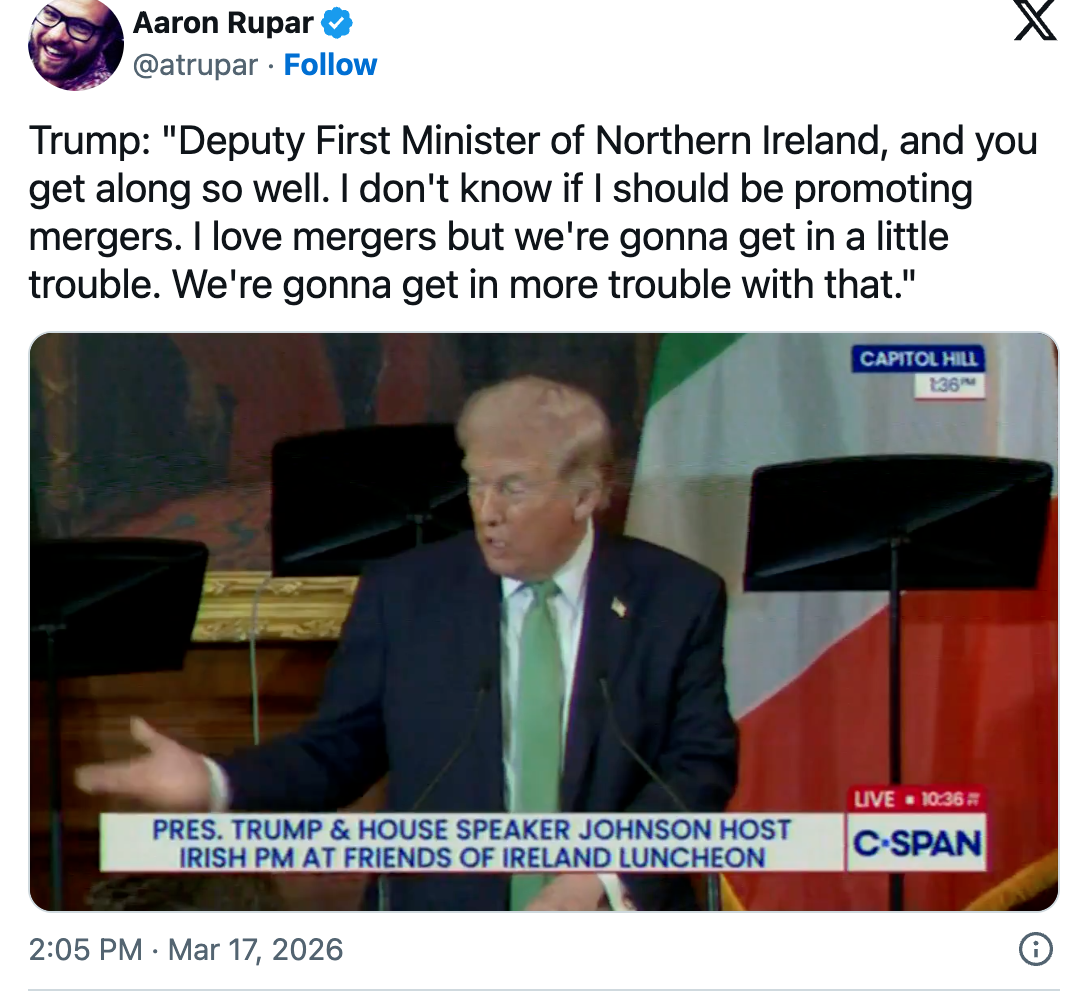
Image from X (formerly twitter) account of Aaron Rupar https://x.com/atrupar/status/2033968096923238404?s=20
Things became rather interesting, across the street at the US Capitol, during the lunch with the Friends of Ireland Caucus. During the lunch President Trump recognized DUP Deputy First Minister of Northern Ireland Emma Little-Pengelly and commented that “you (she and Micheál Martin) get along so well. That’s the way it’s supposed to be. I don’t know if I should be promoting mergers. I love mergers but we’re gonna get in a little trouble. We’re gonna get in more trouble with that. More trouble with that than with the Beauty”. I am not certain to what he was referring to with the beauty comment. A screenshot from Aaron Rupar’s (an independent journalist and publisher of the Public Notice newsletter) post is above with the link to a video of the comment. The comment generated some chuckles and although I was not in attendance I’m sure a few raised eyebrows. There is a current debate with regard to the possibility of a united Ireland. The awkwardness was most likely increased for some given that the First Minister of the Assembly at Stormont Michelle O’Neill was not in attendance due to the U.S.’s involvement in Gaza and the war in Iran.
We’ll see what the 2027 Shamrock Ceremony and Friends of Ireland Caucus has in store for us. In the meantime, if your wondering where the shamrock actually comes from in Ireland check out an article from the Irish Independent from 2025 and this article from the Farmer’s Journal in March of this year, both about the Cools Greenhouse in Ballinskelligs, County Kerry, Ireland. Up the Kingdom!