

“Your Irish Grandparents May Have Provided You With The Golden Door To Europe”
🇮🇪 A Guide To Claiming Irish Dual Citizenship Through Ireland's Foreign Births Register
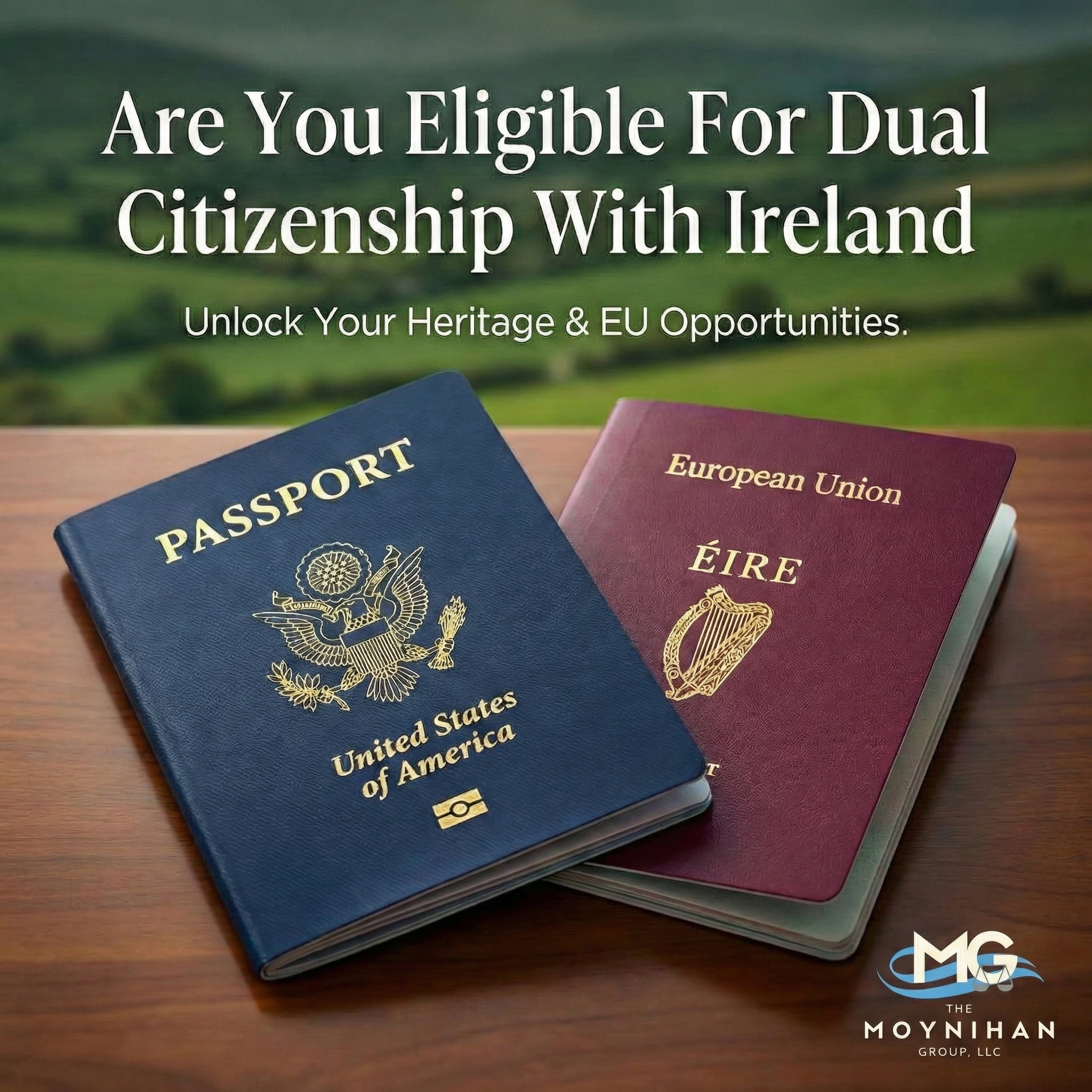
In recent years, many Americans have explored the opportunity to become dual citizens of Ireland and the United States. Whether motivated by family heritage, global mobility, or professional opportunities, Ireland’s Foreign Birth Registration (FBR) process offers a clear path to obtaining Irish citizenship and, ultimately, an Irish passport.
Particularly here in Massachusetts, our connections to Ireland run deep. From the streets of South Boston, to the South Shore, and the neighborhoods of Worcester, the Irish diaspora forms the backbone of many of our communities. We frequently encounter clients who are proudly aware of their heritage and mention their desire to one day "get their Irish passport."
While Ireland boasts one of the most generous citizenship-by-descent programs in the world, the reality of ultimately securing that passport involves a specific, bureaucratic legal process that requires patience and precision.
If your closest link to Ireland is a grandparent born on the island, you are not automatically an Irish citizen at birth. Instead, you have a rightful claim to become one.
This post will outline the legal mechanism for bridging that gap: The Foreign Births Register.
🇮🇪 What Is Foreign Birth Registration?
FBR is Ireland’s citizenship by descent program. The program allows individuals born outside Ireland to claim Irish citizenship if they can trace their heritage through an Irish-born parent or grandparent. Put simply, applying to the FBR is the process of proving the "chain" of life from your Irish-born grandparent, through your parent, to you. You must legally prove that your grandparent was born in Ireland and that you are their direct descendant.
The Foreign Births Register is literally a central government log kept by Ireland’s Department of Foreign Affairs (DFA) recording the births of Irish citizens born outside of the country. Once your birth is entered into the register, you become an Irish citizen and are entitled to apply for an Irish passport.
📌 Eligibility (The Crucial Distinction: Parents vs. Grandparents)
The first step in considering dual citizenship is understanding how you qualify because the law makes a critical distinction based on generation.
1. If your parent was born in Ireland:
If either of your parents was born on the island of Ireland (including Northern Ireland) before you were born, you are likely already an Irish citizen by birth, regardless of where you were born. You usually do not need the Foreign Births Register; you can move straight to applying for a passport.
Note: Exceptions exist, the specifics of which are beyond the elements of this post.
2. If your parent was NOT born in Ireland, but your grandparent WAS:
This is the category most second-or third-generation Irish citizens fall into. You are eligible for citizenship, but it is not automatic and you must apply through FBR.
3. If your parent is an Irish Citizen (through the FBR process):
If your parent successfully claimed Irish citizenship through one of his/her grandparents before you (applicant) were born, then you are eligible to apply through FBR.
In any of the above scenarios, you must formally establish your claim by applying for entry onto the Foreign Births Register. You do not become an Irish citizen until the day your name is officially entered onto this register. Only after that entry can you apply for an Irish passport.
📝 The Paper Chase: Gathering Documentation
The hardest part of this process is not the application form; it is sourcing the required documents. The Irish government is strict. They require long-form, civil state-issued certificates for every major life event in the chain. Church records (baptismal certificates) or short-form birth abstracts are generally not accepted as primary proof.
To successfully apply via FBR, you will generally need to produce original, certified copies of the following for three generations:
The Irish-Born Grandparent:
Long-form civil birth certificate showing parents’ names;
Civil marriage certificate;
If deceased, a certified death certificate.
The Irish Citizen Parent (The Child of the Irish Grandparent):
Long-form civil birth certificate showing parents’ names;
Civil marriage certificate (crucial if name changed upon marriage);
A current, valid photo ID (like a notarized copy of a passport or driver’s license);
If deceased, a certified death certificate.
You (The Applicant):
Your long-form civil birth certificate showing parents’ names;
Your marriage certificate (if applicable, showing name changes);
A certified/notarized copy of your current US passport or driver's license;
Proof of residence/address (utility bills, bank statements, etc.);
Passport sized photos.
Note: If there were divorces, second marriages, or adoptions anywhere along that chain, additional court documents will be required to show the legal progression of names and relationships.
🕰️ The Timeline and Process
The application process has moved largely online in recent years, but the physical evidence must still be mailed to Dublin.
Online Application: You complete the application on Ireland’s DFA website and pay the fee:
Adult €270 .
Minor €145
Non-negotiable mailing fee €8
Document Submission: You print your cover sheet, gather all the original documents listed above, and mail them (we recommend via tracked courier) to the FBR office in Ireland.
The Wait: This is the hardest part. Following COVID-19 closures, a significant backlog developed. While processing times have improved, applicants should still anticipate waiting anywhere from 9 - 10 months for their application to be processed.
The Foreign Birth Registration Certificate: If successful, you will receive a formal Certificate of Entry to the Foreign Births Register in the mail.
Your original documents will be returned separately. Once you hold that certificate, you are legally an Irish citizen and may apply for your passport.
✈️ Benefits of an Irish Passport for U.S. Citizens
Beyond the profound emotional and sentimental value of reconnecting with your ancestry, an Irish passport is a powerful document.
Acquiring Irish citizenship and an Irish passport offers practical and far-reaching advantages:
🌍 Global Travel Freedom
Irish passport holders enjoy unparalleled mobility, with visa-free or visa-on-arrival access to a vast majority of the world’s countries. Ireland’s ranking by the Nomad Passport Index as the top passport in the world for 2025 highlights its global strength.
🇪🇺 Work, Live & Study Across the EU
As an Irish (and EU) citizen, you have the right to live, work, and study anywhere in the European Union without visas or work permits. This includes opportunities in all 27 EU member states.
🇬🇧 Special Rights in the UK
Irish citizens also benefit from special provisions allowing free movement and residence in the United Kingdom under the Common Travel Area.
🧑🎓 Educational Opportunities
Irish citizenship provides access to EU-level tuition and funding opportunities at European universities, which can be significantly more affordable than U.S. out-of-state or international tuition.
🩺 Healthcare Access
Irish citizens can access Ireland’s public health system and, through EU schemes, obtain state-supported healthcare across the EU during temporary stays—benefits unavailable to U.S. passport holders alone.
🏡 Property & Business
Dual citizenship simplifies property ownership and business investment in Ireland and the EU. It eliminates many residency-linked restrictions that non-EU nationals may face and enhances credit and banking opportunities.
🛡️ Consular Protection & Security
As an Irish or EU citizen, you can access consular support from Irish embassies or—where none exists—from any EU member state’s diplomatic mission when abroad.
❓Why Interest in Dual Irish Citizenship Is Rising
Reports show that Americans are increasingly pursuing Irish citizenship through FBR, with substantial growth in U.S. applications in recent years—often driven by the combination of ancestral connection and practical freedoms that Irish citizenship provides. In fact, the number of applications from the U.S. continues to grow annually by 10% or more.
For U.S. citizens with qualifying Irish heritage, dual citizenship is not only a matter of pride and identity, but a strategic gateway to expanded personal and professional horizons.
Keep in mind, FBR is a multi-step process that requires careful documentation and patience—but for many eligible Americans, the rewards are substantial. From the freedom of global travel to expansive opportunities in education, employment, and life in the EU, an Irish passport can be one of the most valuable legal documents you hold.
🆘 How We Can Help - Contact Us for More Information and Support
Many people successfully navigate the FBR process on their own. However, it is document-intensive and unforgiving of errors.
We often see clients run into roadblocks when the "chain" of documentation is broken. This frequently happens due to:
Name discrepancies on old records (e.g., "Nora" on a birth cert but "Honora" on a marriage license);
Difficulty locating records from US states with strict privacy laws;
Complex family structures involving adoptions or multiple divorces.
If you are concerned with the legal complexities of your lineage or if you are struggling to locate and certify the necessary civil records here in the States, our team can help streamline the process and ensure your application package is complete before it crosses the Atlantic.
Disclaimer: This blog post is for informational purposes only and does not constitute legal advice. Immigration and citizenship laws and regulations are subject to change. Please consult with a qualified attorney or the official Irish Department of Foreign Affairs website for specific guidance on your case.